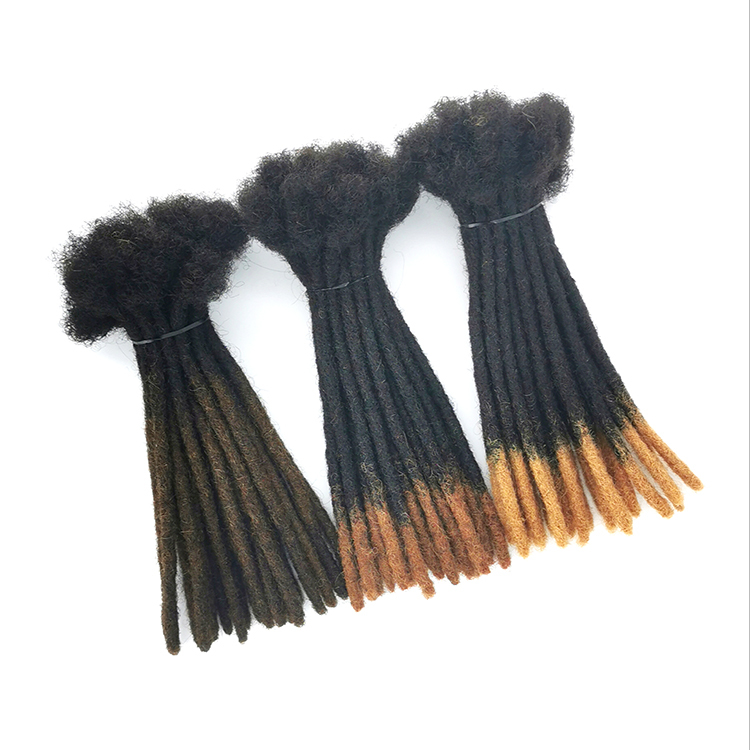
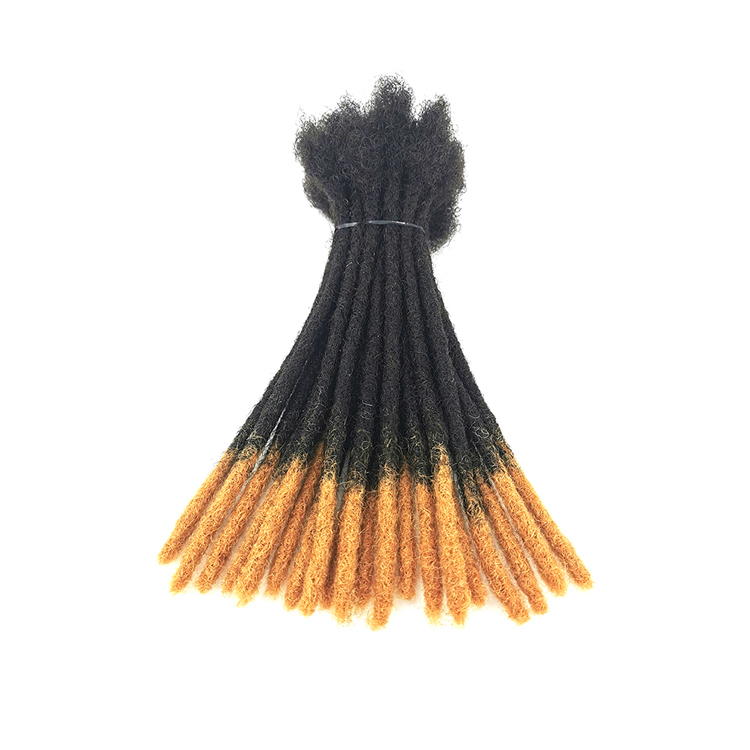
Two loc strands can be made from the same raw hair, sold at similar prices, and behave completely differently over six months of wear. The variable is not the hair. It is how the strand was formed.
1. How the Two Methods Differ
Machine-formed extensions are produced on equipment that compresses and locks fibre at a repeatable rate. Handmade extensions are built strand by strand, with the maker controlling density and tension by feel as the loc is formed. Both are legitimate; they optimise for different things.
Machine production optimises for uniformity and throughput. Handmade production optimises for adaptability - a maker can build a slightly fuller core for a client who needs it, which no fixed machine setting can do.
2. Gauge Uniformity and What It Costs You
Gauge consistency matters more than buyers usually assume, because gauge sets the retightening interval. When every strand arrives at the same diameter, the client's grid maintenance happens on a predictable schedule, and the salon can quote that schedule credibly.
Machine-formed strands hold a tighter gauge tolerance across a batch. Handmade strands vary slightly by nature, and that variation shows up later as a handful of locs that behave differently from their neighbours - usually at the perimeter, where it is most visible.
3. Tension Behaviour Over Time
A loc extension carries tension through its own core, and the client's retightening transfers load at the root. Strands formed with an even internal structure distribute that load predictably. Strands with soft or inconsistent cores can compress in wear, which shows as flattening or as slipping at the root junction after a few maintenance cycles.
4. Matching Method to Service
- High-volume, repeatable services: machine-formed strands, because uniform gauge keeps the maintenance schedule predictable and the chair-time estimate honest.
- Custom fits and unusual density briefs: handmade strands, because the maker can build to a spec the equipment cannot.
- Mixed heads: a deliberate combination - machine-formed for the main grid, handmade at the perimeter where visible variation matters most.
Whichever you standardise on, keep a small reference strand from each batch you buy. Comparing a new batch against a known-good strand takes seconds and catches specification drift before it reaches a client.
The Loc Consistency Comparison Suite
Machine-formed dreadlock extensions alongside handmade dreadlock and soft loc formats for direct comparison of gauge and tension behaviour.